


The EPO Observatory on Patents and Technology has published the study Advancing women in STEM: A data-driven assessment of the gender gap across Europe’s innovation ecosystem, which analyses women’s participation in research, innovation, invention, the patent system and technology entrepreneurship in Europe.
Published ahead of International Women’s Day, the study points to slow progress, but also to the significant untapped innovation potential of women in STEM fields.
Twenty-two national offices contributed to the preparation of the study by supporting promotional and communication activities, as well as by providing information on initiatives being developed at national level to support women in STEM. European institutions and organisations also contributed, including the European Commission (DG Research and Innovation), the European Institute of Innovation and Technology (EIT), the European Institute for Gender Equality (EIGE) and the Institute of Professional Representatives before the European Patent Office (epi).
The study brings together updated patent indicators for all contracting states to the European Patent Convention (EPC), data on European startups from the EPO’s Deep Tech Finder tool, as well as linked data tracking career pathways in STEM fields – from doctoral studies and scientific publications to patenting and entrepreneurship. In this regard, the DOC-TRACK project, an academic research initiative supported under the EPO’s Academic Research Programme (ARP), is of particular importance.
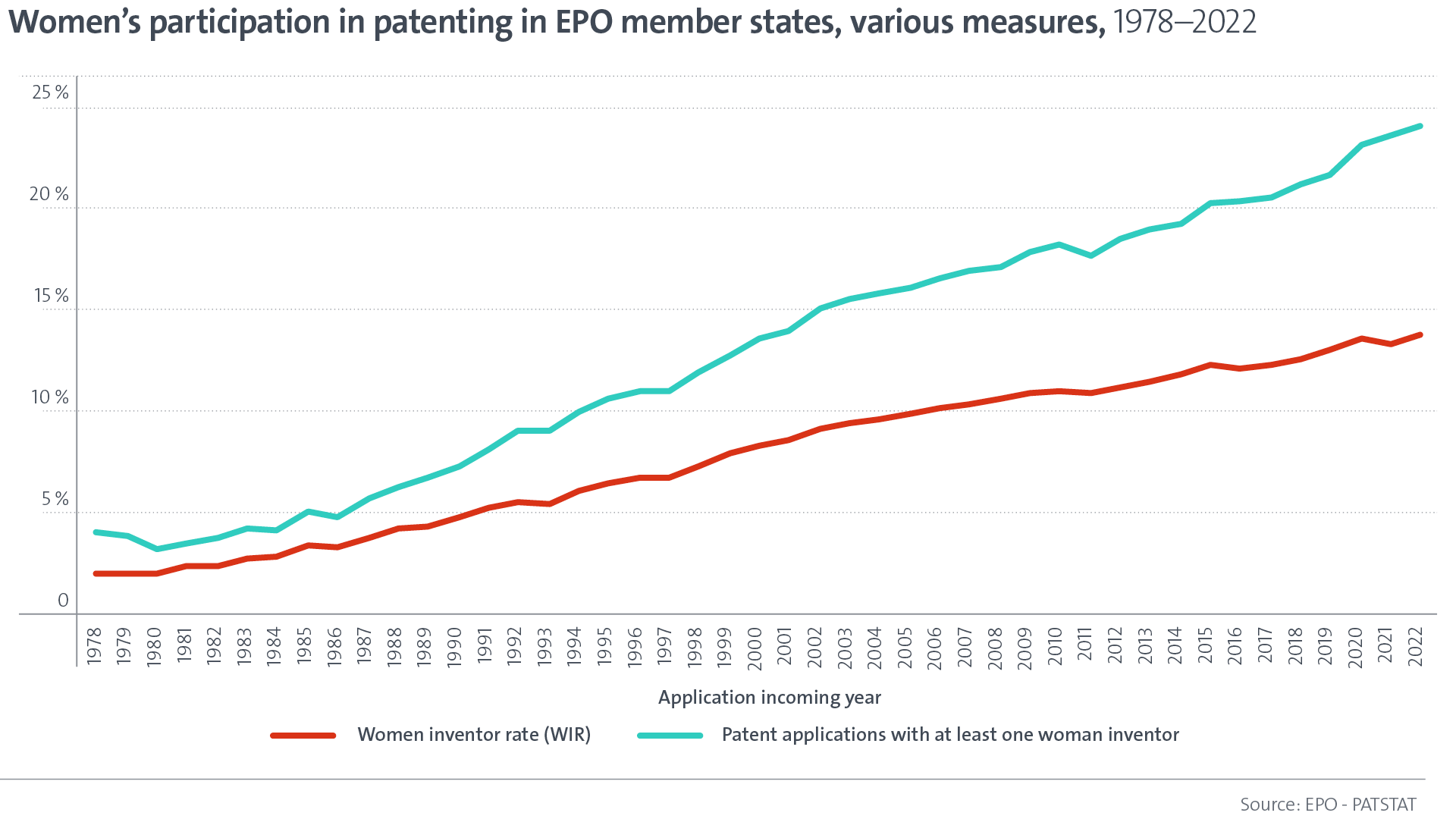
According to the study, the share of women among inventors named in European patent applications reached 13.8% in 2022, representing a slight increase from 13% in 2019. At the same time, the share of European patent applications naming at least one woman inventor rose from 21.6% in 2019 to 24.1% in 2022, indicating greater participation of women in team-based inventive work. The highest shares of women were recorded in pharmaceuticals (34.9%), biotechnology (34.2%) and food chemistry (32.3%), while the lowest were found in machine tools (5.7%), basic communication processes (5.5%) and mechanical elements (4.9%).
When it comes to different types of patent applicants, universities and public research organisations show a significantly higher share of women inventors (24.4%) compared to companies (11.6%) and individual inventors (12.5%). These figures suggest that the gender gap widens in the transition from the academic environment to the business and commercial application of innovation.
The study also shows that the gender gap is particularly pronounced among startups engaged in patenting activities. Women account for around 10% of founders of European technology startups that have filed European patent applications, while 13.5% of such startups have at least one woman founder. By comparison, among startups without patenting activities, the share of women founders stands at 17.4%, confirming that the gender gap is more pronounced in high-tech and patent-intensive ventures.
More recent startups show a somewhat more favourable picture: in startups younger than five years, women account for 14% of founders, while in companies older than 20 years, that share is 5.9%. However, women’s participation declines in later stages of growth and financing, pointing to additional challenges women face in developing and scaling technology companies.
In patent-related professions, women’s participation is higher than among inventors. In 2025, women accounted for 25.5% of patent examiners at the EPO, more than 30% of new recruits, and 29.2% of European patent attorneys.
The study also points to a gradual decline in women’s participation throughout the educational and career pathway in STEM fields. Although women account for around 37% of PhD graduates in STEM fields in the European Union, they are approximately half as likely as men to go on to become inventors. At the same time, the analysis shows that women’s research has innovation potential comparable to that of men’s research, suggesting that the causes of women’s lower participation in patenting are primarily sociological, institutional and economic in nature.
In addition to statistical indicators, the study also highlights positive examples from practice by presenting profiles of four successful women inventors: Dame Carol Robinson and Cordelia Schmid, winners of the European Inventor Award, as well as Pilar Granado and Marie Perrin, winners of the Young Inventors Prize.
Learn more and read the full study at the following link.